FYI: I wrote a short piece for the LTO newsletter on page 6:
http://www.ryerson.ca/lt/about/exchange_newsletter/march08.pdf
Tuesday, April 8, 2008


Monday, March 24, 2008
"hey, remember that book review you did..."
so my review of the new media handbook and the media literacy reader finally got published in issue 1 of vol. 23 of Visual Studies, Apr. 2008. please read it now, regardless of what continent you are on.
http://dx.doi.org/10.1080/14725860801908585
http://dx.doi.org/10.1080/14725860801908585
Tuesday, March 11, 2008
IDRC Doctoral Research Awards
These awards are relevant to a few of us, I think.
1) IDRC Doctoral Research Awards
Deadline to receive applications: April 1, 2008
For more information: http://www.idrc.ca/awards/ev-23374-201-1-DO_TOPIC.html
Bourses du CRDI aux chercheurs candidates au doctorat
Date limite pour recevoir les demandes : le 1er avril 2008
Pour plus d’informations : http://www.idrc.ca/fr/ev-23374-201-1-DO_TOPIC.html
--------------------------------------------------------------------------------------------------------------------------
2) Canadian Window on International Development
Deadline to receive applications: April 1, 2008
For more information: http://www.idrc.ca/en/ev-23376-201-1-DO_TOPIC.html
Bourses Regard canadien sur le développement international
Date limite pour recevoir les demandes : le 1er avril 2008
Pour plus d’informations : http://www.idrc.ca/fr/ev-23376-201-1-DO_TOPIC.html
--------------------------------------------------------------------------------------------------------------------------
3) Ecopolis Graduate Research and Design Awards
Deadline to receive applications: May 15, 2008
For more information: http://www.idrc.ca/en/ev-88111-201-1-DO_TOPIC.html
Bourses de recherche et design Écopolis
Date limite pour recevoir les demandes : le 15 mai 2008
Pour plus d’informations : http://www.idrc.ca/fr/ev-88111-201-1-DO_TOPIC.html
1) IDRC Doctoral Research Awards
Deadline to receive applications: April 1, 2008
For more information: http://www.idrc.ca/awards/ev
Bourses du CRDI aux chercheurs candidates au doctorat
Date limite pour recevoir les demandes : le 1er avril 2008
Pour plus d’informations : http://www.idrc.ca/fr/ev-23374
------------------------------
2) Canadian Window on International Development
Deadline to receive applications: April 1, 2008
For more information: http://www.idrc.ca/en/ev-23376
Bourses Regard canadien sur le développement international
Date limite pour recevoir les demandes : le 1er avril 2008
Pour plus d’informations : http://www.idrc.ca/fr/ev-23376
------------------------------
3) Ecopolis Graduate Research and Design Awards
Deadline to receive applications: May 15, 2008
For more information: http://www.idrc.ca/en/ev-88111
Bourses de recherche et design Écopolis
Date limite pour recevoir les demandes : le 15 mai 2008
Pour plus d’informations : http://www.idrc.ca/fr/ev-88111
Monday, March 10, 2008
Resilience theory and learning
Based on the idea of resilience and the adaptive cycle (below) Garry Peterson identified three different types of learning:
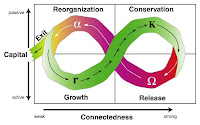
- Incremental, (r to K)
- Lurching, (omega to alpha)
- Transforming, (panarchical)
Incremental change and learning. This type of change
occurs in the predictable development phase or from the r to K phase of the
adaptive cycle. During these phases, models or schemas are assumed to be
correct, and learning is characterized by collecting data or information to
update these models. This type of learning is similar to the single loop
learning of Argyris and Schon (1978). In bureaucratically dominated resource systems, the activity of learning is carried out largely by self-referential professionals or technocrats, who primarily view dealing with this type of change and learning as problem solution (Westley, in Press).
Abrupt Change and Spasmodic Learning. This type of
change is episodic, discontinuous and surprising. It is created by slow-fast
dynamics that reveal the inadequacies of the underlying model or schema
structure. It is the change described by transitions from the conservation phase (K) through the omega and renewal phases of the adaptive cycle. This can be manifest as an environmental crisis, where policy failure is undeniable
(Gunderson et al., 1995) and results from an environmental cognitive dissonance. In this case, the learning is described as double-loop, where the underlying model or schema is questioned and rejected (Argyris and Schon, 1978). This is also characterized as problem reformation. In bureaucratic resource systems, this type of learning is facilitated by outside groups or charismatic integrators.
Transformational Learning. This is the most dramatic
type of change and requires the deepest type of learning. Cross-scale surprise or novelty surprises characterize this type of change and are related to
interaction between different sets of labile variables. In these cases, learning
involves solving problems of identifying problem domains, among sets of wicked and complex variables (Westley, in press). This is also described as
evolutionary learning (Parsons and Clark, 1995) where not just new models or schema are developed, but also new paradigmatic structures (sensu Kuhn,
1970).
Argyris, C. and D. A. Schon. 1978. Organizational Learning: A Theory of Action Perspective. Addison-Wesley, Reading.
Parsons, E. and W. Clark. 1995. Sustainable Development as Social Learning. In, Barriers and Bridges to the Renewal of Ecosystems and Institutions. Columbia University Press, New York.
Westley, F. In Prep. The Devil in the Dynamics: Adaptive Management on the Front Lines. In Theories for Sustainable Futures. Gunderson and Holling, editors. Island Press.
Thursday, March 6, 2008
Self-promotion (shameless)
I am happy to report that I have been publicated! Mind you, not a peer-reviewed venue but as part of a series of grad student papers from FES. So now when I refer to "(Berbes, 2007)", you know what I'm talking about ;)
Here is the abstract:
To full paper is available on FES Outstanding Graduate Student Paper Series. Kris, the literature review has some stuff on systems theory that may be of interest.
Here is the abstract:
Environmental crises have prompted a re-evaluation of traditional approaches to environmental management that has often highlighted their inability to deal with the complexity of social-ecological systems. The ecosystem approach (EA) offers an alternative that combines ideas from systems theory, participatory decision-making and adaptive management. However, EAs are still relatively young both as a discipline and as a practice, and as such, their meaning is continuously being redefined. This paper assesses the current state of development and the direction of EAs in the Golden Horseshoe Region (Ontario) by analyzing quantitative and qualitative data from interviews with EA practitioners. Practitioners were involved in projects that applied EA in a variety of fronts from ecological restoration to eco-health to urban development. The survey used helped to identify the theoretical foundations and core themes of EA; the methods, techniques and tools used; and, the factors and barriers to its implementation and potential application to other contexts. Two findings emerged from this research: first, despite the diversity of practitioners and applications, the theoretical understandings of EA are coalescing into a unified view that emphasizes the principles of integration, connectivity and participation. Second, successful implementation of EAs will require a parallel shift in the current institutional setting towards more adaptive forms of governance. Despite this obstacle EA continues to spread to applications in the fields of eco-health and urban development.
To full paper is available on FES Outstanding Graduate Student Paper Series. Kris, the literature review has some stuff on systems theory that may be of interest.
I wish I had studied this instead....
Check this out! I wish I could go. Why have I wasted my time studying resources when I could have studied Hip Hop?
HIPHOP BLACK GLOBALITY
AND VERNACULAR COSMPOLITANISM
IN THE NEW SOUTH AFRICA
Remi Warner
Tuesday, March 11, 2008
2:00 p.m. – 4:00 p.m.
286C Winters College
Drawing on my year-long fieldwork in Cape Town and Johannesburg, South Africa, my presentation examines some of the
ways in which globally circulating hiphop popular musical-cultural forms and practices have been appropriated and
deployed by South African youth to negotiate contemporary and inherited legacies of ascriptive ethnic and racial
identification. I introduce and discuss the concept of ‘Black Globality’ as an alternative framework for understanding the
multiple, varied, and shifting kinds of identifications, affiliations and social imaginaries forged by and between citizens of
the global hiphop nation. The presentation focuses in particular on ‘vernacular cosmopolitan’ hiphop cultural practices
produced under conditions of Black Globality, a primary outcome of which, I argue, is an agonistic ‘fusion of horizons’ and
re-invigorated ethico-political debate.
Remi Warner has a PhD in Social Anthropology from York University. His research explores the politics and poetics of race
and place and the impact of the globalization of Black popular culture on youth identity, cultural politics and racial
formation in post-apartheid Cape Town and Johannesburg. He has also published on Hip Hop in Canada. He currently works
as a researcher with the provincial government while also teaching an undergraduate course, Race, Racism and Popular
Culture, in York’s Department of Anthropology.
For more information contact:
Professor Daniel Yon
Faculty of Education
Tel: 416-736-2100 ext. 88806
Email: dyon@edu.yorku.ca
Wednesday, March 5, 2008
Selection criteria
After I sent emails to the departments stating I have questions on the way, I made this selection criteria chart today:
Are there any categories I might be missing? Any refinement to categories (such as Research on topic of research group category).
| Criteria | | | Job | Weight | Score |
| Professors-calibre/subject | | | | | |
| Professors-social | | | | | |
| Supportive research group | | | | | |
| Research on topic of research group | | | | | |
| Faculty/department socializing | | | | | |
| Current financial support | | | | | |
| Potential for increased financial support | | | | | |
| Support for publishing/conferences | | | | | |
| Support for finishing in 3 to 4 | | | | | |
| City-socializing/liveability | | | | | |
| City-culture/adventure | | | | | |
| Health | | | | | |
| Predicted level of fulfillment | | | | | |
Are there any categories I might be missing? Any refinement to categories (such as Research on topic of research group category).
Tuesday, March 4, 2008
Back to the Applicators: Payments and Restrictions
I'm still onto looking at all of my parameters for making a decision for Calgary vs. Waterloo and putting together my evaluation grid (incorporating Marta's expertise), and I am a bit confused about the funding component in terms of invisible funding "ceilings". Both Waterloo and Calgary have offered similar base funding, but now I am confused about the additional funding, which I would like to get.
For instance, at Calgary, if you receive a Faculty of Graduate Studies award, and then another award valued the same or higher, you have to GIVE BACK the FGS award. While I understand the concept, I'm now not sure if they make me reject my department award if I get a $15,000 award, and if this limits my funding possibilities.
According to Waterloo's funding guidelines if you get a provincial or national scholarship, they throw MORE money at you, not less. BUT you still have to check your departments funding guidelines on how they deal with awards (for instance, do they pull some of your base funding?).
So, while they currently both offer similar funding, I want to make sure that there is possibility of more funding potential, rather than a possibly low ceiling placed on my income for those years.
Has anyone else put some thought into this practical side?
thoughts on timing, scheduling, and self-discipline
it was a nice breakfast/brunch we had the other day, tho' i think i was a little insistent in my talk of timelines and scheduling and work habits. that said, i thought (or 'thot') i'd put my money where my mouth is & post about my attempt at planning a weekly schedule. having just been accepted to present at Congress at the Canadian Communications Association (CCA) conference in June in Vancouver, i figure this is better done now than later.
so first, i thought about what a reasonable work week would be. 10 hours per weekday plus another 10 over the weekend is a 60 hour work week, but with reading and writing constituting a big chunk of that, it isn't an overwhelming schedule, I believe.
Then I thought about what that would be (w/ a running total at the end of each point):
+ 10 hours a TA-ship (that's the easy one, and it gives me bonus time in the summer, or if I choose not to do a TA-ship one semester: 50 hours remaining)
+ 2 hrs/day writing = 14 hrs. (i thought whether this would be lumped into weekends or free days, or rigidly scheduled into the activities of each day. i don't yet have an answer for that, but the 14 hour weekly max. gives some flexibility: 36 hours remaining)
+ 2 hrs./day reading = 14 hrs. (this includes researching, annotating, and note-taking, which might also be considered writing, tho' i'd like to develop a habit of doing research directly into the computer, so i don't have to filter through post-it notes at a later date. i've had success doing this with précis-writing, tho' it's not yet instinctive enough a practice. "writing" proper i'd like to devote to synthesis and analysis and more creative activities: 22 hours remaining)
+ 3 hrs./weekly supervisory meetings (maybe ambitious, but i would like to be working closely with my supervisor[s], either supporting their work through my collaboration, or discussing my own progress with them. i'd like to institute this early and make it an ongoing activity... i guess the challenge is getting my supervisor to buy in: 19 hours remaining)
+ 6-9 hrs./weekly in-class, coursework (this may include course audits, unaccredited coursework. ideally i'll be taking two in a semester, tho' three courses may be a necessity at times. in any case, i'll say 9 hours to give myself some space to do readings without cutting too deeply into my own research: 10 hours remaining)
+ 7 hrs./weekly peer meetings (the formal side of socializing, this would include TA development activities, participation in grad student association meetings, peer presentations of work-in-progress, local symposiums/panels/etc., gallery openings, and so on. i've averaged an hour per day on this, tho' it'll likely cluster: 3 hours remaining)
So the grand total is 57 hours, meaning I have 3 to spare! Of course I'm not factoring in transportation in this equation, and 3 hours hardly counts for that. But as a set of upper limits, hopefully that makes sense.
the question now is whether i "enforce" my restrictions, and how do i do it? (apologies in advance for sounding so anal in this section, but i'm just trying to work a problem through.) for example: say there's a number of interesting peer activities going on in a week that would take me above my alloted 7 hours: do i say no to them? do i cut into my reading or writing or some other time to attend? do i "bank" hours from week to week, or does each week start as a blank slate? how do i determine when things need to change—do i redo this weekly plan every few months or so?
many questions. i only hope by addressing them like i have here that i'm working toward a viable solution rather than a compulsive disorder (the use of the term "self-discipline" in the title makes me feel really squirmy...)
CFP: Active History - History for the Future
Deadline: March 31
for Sept. 27-28 @ York U.
Kris says: a little outside of our areas, but in the interests of historicizing lit. reviews that we all want to do, maybe this is a useful prompt? (tho' maybe not...)
for Sept. 27-28 @ York U.
Kris says: a little outside of our areas, but in the interests of historicizing lit. reviews that we all want to do, maybe this is a useful prompt? (tho' maybe not...)
Call for presentations, panels and round tables:http://www.h-net.org/announce/show.cgi?ID=161146
We are seeking applications from historians with multiple perspectives on active history. We encourage both historians working inside and outside the academy to contribute to the symposium. This is a call for presentations, not papers, as we welcome different approaches to communicating ideas about active history. Please send a one page proposal for a presentation, panel or round table, along with a brief CV of the presenter or presenters, to Jim Clifford by March 31, 2008: cljim22@gmail.com or History Department, 2172 Vari Hall, York University, 4700 Keele St., Toronto, ON, M3J 1P3.
Subscribe to:
Posts (Atom)