hey all--
looking for a map of educational theories from any era (19th C. to present), particularly if they address connections between theories of learning (psychological, sociological, philosophical) with policy implementation.
i know the big names i want to address in my comps (e.g. Dewey, Freire, Vygotsky, Piaget, etc.), but i'd like to see how someone else has conceived of their interrelatedness in order either to build on this conception or critique it.
Thanks; oh, and any ideas on the name change?? Or should it remain publicators?
-k.
Showing posts with label education. Show all posts
Showing posts with label education. Show all posts
Thursday, October 22, 2009


Thursday, June 12, 2008
temple uni. (philadelphia, pa) exchange programs
... none of which require you to actually go to Philadelphia (tho' i have heard it's a wonderful town):
http://www.temple.edu/studyabroad/programs/summer/index.html
thought i'd share it because it's not all anthropology, and not all in Japan. (tho' no costa rica, there is Ghana, Jamaica, Mexico, Senegal, and Spain...)
it is, however, not inexpensive.
-k
http://www.temple.edu/studyabroad/programs/summer/index.html
thought i'd share it because it's not all anthropology, and not all in Japan. (tho' no costa rica, there is Ghana, Jamaica, Mexico, Senegal, and Spain...)
it is, however, not inexpensive.
-k
Friday, May 23, 2008
CFP: Environment, Curriculum and Education
another one of interest, perhaps (oh, and no apparent deadline, since they want to publish it serially over the next few years?? not sure; here it is anyway):
The Journal of Curriculum Studies (JCS) welcomes submissions for a forthcoming special issue on "Environment, Curriculum and Education"

For full details please visit http://www.tandf.co.uk/journals/cfp/tcuscfp1.pdf

Since the 1970s, the state of the environment and pathways toward sustainability have both emerged and been contested as onjects of political and pedagogic discourse in a range of institutions and places throughout the world. Often ties to shifts in and a broadening of ecological consciousness, it can also be noted that various attempts to "green" civil society and structures have led to mixed responses on the part of new social movements and formations, schools and communities, and business and governance, amongst others.

The Journal of Curriculum Studies seeks to publish a series of scholarly articles and essays on "Environmental, Curriculum and Education". Papers might address, but are not limited to, inquiries about:

- the politics and philosophy of the environment and / or sustainability in teaching, learning and the curriculum
- contemporary and possible purposes, expectations and policies shaping formal education systems
- the relationship between academic environmental and sustainability research and scholarship and the curriculum

To read the full Special Call for Submissions please visit http://www.tandf.co.uk/journals/cfp/tcuscfp1.pdf

For more information and the Journal of Curriculum Studies, please visit www.informaworld.com/jcs

Submissions should be sent to Alan Reid, special editor for the "Education, Curriculum and Education" strand of Journal of Curriculum Studies.

Alan Reid is Editor of Environmental Education Research. Please visit www.informaworld.com/eer for more details.
Tuesday, May 20, 2008
summer sessions at OCAD
seems like the more interesting, "hands-on" sessions are the shorter ones running through June, and the others run later. either way, seems fun!
http://www.akimbo.biz/workshops/?id=11254
http://www.akimbo.biz/workshops/?id=11254
Friday, May 2, 2008
infed.org - informal education
more about sharing links for Matt:
http://www.infed.org/
...this one's a site about informal and, in particular, experiential education--the latter of which is a key part of the tradition in environmental education.
they're also asking for contributions, in an online format, so if you have any ideas... check out their homepage
http://www.infed.org/
...this one's a site about informal and, in particular, experiential education--the latter of which is a key part of the tradition in environmental education.
they're also asking for contributions, in an online format, so if you have any ideas... check out their homepage
Canadian Network for Environmental Education and Communication
I came across the Canadian Network for Environmental Education and Communication (EECOM) which describes themselves as:
"Canada’s only, national, bilingual, network for environmental education and communication. We are a membership-based, charitable organization that is multi-disciplinary, multi-regional, multi-cultural and multi-sectoral. We work with provincial groups and multiple sectors to support and develop competency in educators, communicators, learners and consumers, and build capacity for environmental learning and sustainability."
It fits very well with Matt's interests, although they don't sound overly academic. A good and a bad thing, I suppose. They have a conference coming up on September, Sarah Harmer is a keynote speaker too?!
"Canada’s only, national, bilingual, network for environmental education and communication. We are a membership-based, charitable organization that is multi-disciplinary, multi-regional, multi-cultural and multi-sectoral. We work with provincial groups and multiple sectors to support and develop competency in educators, communicators, learners and consumers, and build capacity for environmental learning and sustainability."
It fits very well with Matt's interests, although they don't sound overly academic. A good and a bad thing, I suppose. They have a conference coming up on September, Sarah Harmer is a keynote speaker too?!
Monday, March 10, 2008
Resilience theory and learning
Based on the idea of resilience and the adaptive cycle (below) Garry Peterson identified three different types of learning:
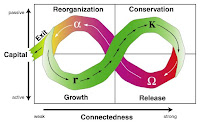
- Incremental, (r to K)
- Lurching, (omega to alpha)
- Transforming, (panarchical)
Incremental change and learning. This type of change
occurs in the predictable development phase or from the r to K phase of the
adaptive cycle. During these phases, models or schemas are assumed to be
correct, and learning is characterized by collecting data or information to
update these models. This type of learning is similar to the single loop
learning of Argyris and Schon (1978). In bureaucratically dominated resource systems, the activity of learning is carried out largely by self-referential professionals or technocrats, who primarily view dealing with this type of change and learning as problem solution (Westley, in Press).
Abrupt Change and Spasmodic Learning. This type of
change is episodic, discontinuous and surprising. It is created by slow-fast
dynamics that reveal the inadequacies of the underlying model or schema
structure. It is the change described by transitions from the conservation phase (K) through the omega and renewal phases of the adaptive cycle. This can be manifest as an environmental crisis, where policy failure is undeniable
(Gunderson et al., 1995) and results from an environmental cognitive dissonance. In this case, the learning is described as double-loop, where the underlying model or schema is questioned and rejected (Argyris and Schon, 1978). This is also characterized as problem reformation. In bureaucratic resource systems, this type of learning is facilitated by outside groups or charismatic integrators.
Transformational Learning. This is the most dramatic
type of change and requires the deepest type of learning. Cross-scale surprise or novelty surprises characterize this type of change and are related to
interaction between different sets of labile variables. In these cases, learning
involves solving problems of identifying problem domains, among sets of wicked and complex variables (Westley, in press). This is also described as
evolutionary learning (Parsons and Clark, 1995) where not just new models or schema are developed, but also new paradigmatic structures (sensu Kuhn,
1970).
Argyris, C. and D. A. Schon. 1978. Organizational Learning: A Theory of Action Perspective. Addison-Wesley, Reading.
Parsons, E. and W. Clark. 1995. Sustainable Development as Social Learning. In, Barriers and Bridges to the Renewal of Ecosystems and Institutions. Columbia University Press, New York.
Westley, F. In Prep. The Devil in the Dynamics: Adaptive Management on the Front Lines. In Theories for Sustainable Futures. Gunderson and Holling, editors. Island Press.
Saturday, March 1, 2008
Research at Cornell
You know, in this day and age where you can find everything and anything through Google, or e-Bay, I still find it surprisingly difficult to know which schools are hot hubs for what. And it is not for lack of shameless self-promotion on the part of universities. Luckily, traditional ways are still useful in this respect and someone pointed out to me that Cornell University is doing some really fun stuff education-wise.
Edukators, take a look.
Edukators, take a look.
Thursday, February 21, 2008
Responding to Freire: a beginning
It’s hard to comment on Freire when I haven’t read what I imagine to be a library of responses to his work. So I don’t know if I’m repeating what others have already said or adding something new. I know from reading postings on the website (http://www.oise.utoronto.ca/research/edu20/) that there are common themes in people’s reaction to his work, and I too address some of these themes. I think within the context of the website, at least, what I have to say should be of interest. It certainly has been helpful for me to have this site to post my thoughts and thereby engage further with Paulo Freire and those sharing an interest in his work. Also, my post is a little different from the others in that it’s not so much a book review as it is a response to what I see as problems and opportunities for using Freire’s work to develop an approach to understanding human-nature relations today.
Education, for Paulo Freire, had to be an emancipatory force, one that would contribute to human development. His goal was to help illiterate people learn how to use language to engage with the “themes of their time.” In setting parameters for this educational project Freire articulated a set of inter-related distinctions between culture and nature, people and animals, the rational and the emotional, the causal and the magical, communication and extension, among others. These distinctions gave meaning and direction to Freire’s work, and other scholars have raised important criticisms about them. What seems to be missing, however, is an explanation as to why Freire’s framework continues to have widespread appeal: people around the world – in conditions that are likely quite different from those that influenced Freire – continue to be inspired by his methodology and vision. This paper considers the core distinctions of Freire’s theoretical framework, some problems associated with them, and why the framework continues to inspire scholars. In particular, I’m interested in the contributions that Freire’s framework might make to current debates within the pedagogy of environmental studies and transforming human-nature relations.
A set of inter-related distinctions
Freire believed that education ought to contribute to human development. Making sense of this development required a way of distinguishing between different states of human existence—a progression along a spectrum with degrees of human liberation. First, to define the spectrum itself, Freire needed to establish something concrete about what it meant to be human. He turned to a distinction between humans and animals. While animal behaviour could be best understood as a reflex to the world, humans related to the world through culture: humans had the unique ability to make sense of the world and to intervene in reality—to transform it. It was this human capacity for reflection, decision-making – in short consciousness – that Freire wanted to develop.
Next, Freire distinguished between different states of consciousness, suggesting that some states were further along the path towards critical consciousness than others. On the one end of this spectrum there was “semi-intransitivity of consciousness,” a state of limited comprehension of one’s immediate surroundings where “[m]en [sic] confuse their perceptions of the objects and challenges of the environment, and fall prey to magical explanations because they cannot apprehend true causality” (Freire 1973: 17). “Naïve transitivity” was not much better, “characterized by an over-simplification of problems; by a nostalgia for the past; by underestimation of the common man; by a strong tendency to gregariousness; [....]"
Education, for Paulo Freire, had to be an emancipatory force, one that would contribute to human development. His goal was to help illiterate people learn how to use language to engage with the “themes of their time.” In setting parameters for this educational project Freire articulated a set of inter-related distinctions between culture and nature, people and animals, the rational and the emotional, the causal and the magical, communication and extension, among others. These distinctions gave meaning and direction to Freire’s work, and other scholars have raised important criticisms about them. What seems to be missing, however, is an explanation as to why Freire’s framework continues to have widespread appeal: people around the world – in conditions that are likely quite different from those that influenced Freire – continue to be inspired by his methodology and vision. This paper considers the core distinctions of Freire’s theoretical framework, some problems associated with them, and why the framework continues to inspire scholars. In particular, I’m interested in the contributions that Freire’s framework might make to current debates within the pedagogy of environmental studies and transforming human-nature relations.
A set of inter-related distinctions
Freire believed that education ought to contribute to human development. Making sense of this development required a way of distinguishing between different states of human existence—a progression along a spectrum with degrees of human liberation. First, to define the spectrum itself, Freire needed to establish something concrete about what it meant to be human. He turned to a distinction between humans and animals. While animal behaviour could be best understood as a reflex to the world, humans related to the world through culture: humans had the unique ability to make sense of the world and to intervene in reality—to transform it. It was this human capacity for reflection, decision-making – in short consciousness – that Freire wanted to develop.
Next, Freire distinguished between different states of consciousness, suggesting that some states were further along the path towards critical consciousness than others. On the one end of this spectrum there was “semi-intransitivity of consciousness,” a state of limited comprehension of one’s immediate surroundings where “[m]en [sic] confuse their perceptions of the objects and challenges of the environment, and fall prey to magical explanations because they cannot apprehend true causality” (Freire 1973: 17). “Naïve transitivity” was not much better, “characterized by an over-simplification of problems; by a nostalgia for the past; by underestimation of the common man; by a strong tendency to gregariousness; [....]"
Subscribe to:
Posts (Atom)